Feast Day: October 4th
Patron Saint of Animals, Ecology, Franciscan Order, Italy
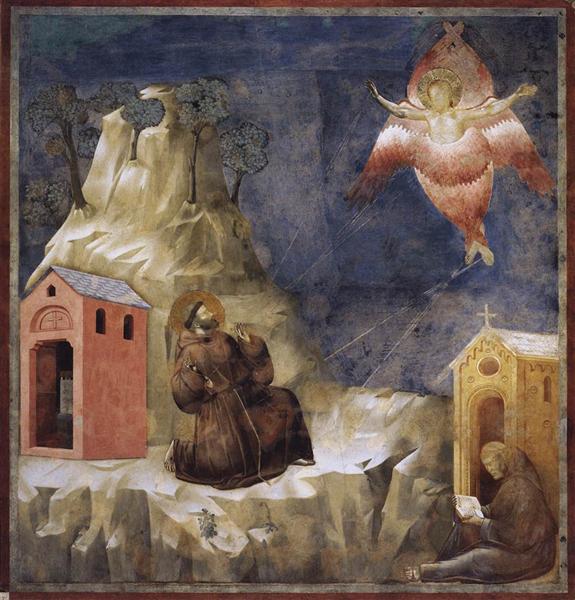
Artist: Giotto di Bondone. Date: ca. 1297–1300. Location: Basilica of San Francesco, Assisi. Credit: “Giotto, Stigmatization of St. Francis, ca. 1297–1300. Public Domain image via WikiArt.”
This fresco depicts St. Francis receiving the stigmata, the wounds of Christ, while praying on Mount La Verna in 1224. It is located in the Upper Church of the Basilica of San Francesco in Assisi, part of a larger cycle illustrating the life of St. Francis. The painting captures the spiritual intensity of the moment, showing Francis’s complete surrender to God and his intimate union with Christ.
Pope St. Gregory the Great
Faith Journey
Born in Assisi in 1181/82 to a prosperous merchant family, Francis enjoyed wealth, privilege, and youthful pursuits. At age 20, St. Francis took part in a military campaign and was taken prison for a year. During this time, he became seriously ill and began to reflect deeply on his life and purpose which helped prepare him for his later spiritual conversion and renunciation of worldly wealth.
Renouncing his inheritance in a dramatic act before the Bishop of Assisi, Francis gave up all that he owned, even the clothes he wore, to show that he now belonged completely to God. Embracing a life of poverty and trust in God’s care, he dedicated himself to prayer, service, and rebuilding small, ruined churches as a sign of renewing the Church itself.
Inspired by his joy and radical simplicity, others soon gathered around him, forming the nucleus of the Franciscan movement.
Approved by Pope Innocent III in 1209, the order spread rapidly, preaching penance and peace while living in poverty.
Marked by love of creation and devotion to Christ’s Passion, Francis had a vision of the Crucified Lord
in the form of a seraph becoming the first known saint to bear Christ’s wounds.
He died in 1226 at the Portiuncula, embraced by his brothers, and was canonized only two years later.
His feast day, October 4, celebrates a legacy of humility, love of creation, and fidelity to the Gospel that continues to inspire the Church and the world.
Challenges and Virtues
Francis’s journey to holiness was marked by both external and internal challenges. Born into wealth and comfort, he initially dreamed of knighthood and glory in battle. He experienced the hardships of war firsthand, including being captured and imprisoned for a year, which humbled him and prompted a deep conversion. Rejecting his father’s fortune and worldly ambitions, he embraced radical poverty—a choice that drew misunderstanding, ridicule, and rejection even within the Church. Later in life, Francis bore the stigmata, the wounds of Christ, on his hands, feet, and side, which he carried for the final two years of his life, enduring intense physical suffering with patience and devotion.
Despite these trials, Francis radiated joy, simplicity, and trust in God. His humility was evident in living among the poor and lepers, his charity in embracing all creation as his brothers and sisters, and his courage in challenging pride and greed with the Gospel. He balanced fervent zeal with gentle compassion, inspiring followers through example rather than authority.
The virtues that shine through Francis’s life—humility in renouncing privilege, courage in the face of war and suffering, love for all creatures, joy in carrying Christ’s wounds, and zeal for the Gospel—remind us that holiness is not found in comfort but in surrendering everything to God and living fully in His love.
Canonization and Legacy
Francis was canonized only two years after his death, on July 16, 1228, by Pope Gregory IX. His remains, interred at the Basilica of St. Francis in Assisi, were lost for nearly 600 years due to repeated thefts and relocations, yet his tomb remains a major pilgrimage site. Francis’s legacy endures in the Church through the Franciscan Order, which continues his mission of poverty, simplicity, and service to the poor.
The legacy of St. Francis lives on through three religous order he founded; The Franciscans, The Poor Clares, and the Third order of St. Francis. St. Francis is one of the most selected saints for Confirmation, inspiring young Catholics with his radical love for God, care for creation, and devotion to Christ.
Today, he is also celebrated worldwide as a symbol of peace, humility, and environmental stewardship, making him one of the most well-known and beloved saints in Christian history.
The San Damiano Cross
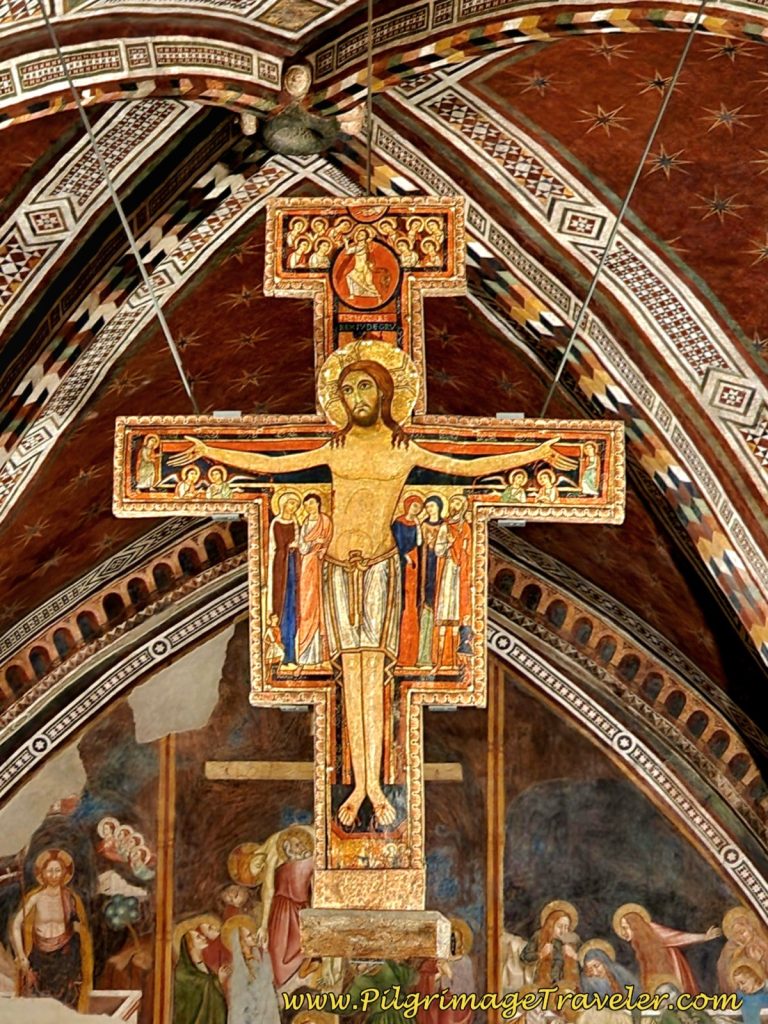
San Damiano Crucifix – Wikimedia Commons
The San Damiano Cross is a large painted Byzantine-style icon cross, created by an unknown Umbrian artist sometime in the 12th century. This crucifix that played a pivotal role in the life of St. Francis of Assisi. It originally hung in the small church of San Damiano near Assisi, Italy, where Francis often prayed. According to tradition, while Francis knelt before this cross in 1205, he heard the voice of Christ saying, “Go, rebuild my Church, which, as you can see, is falling into ruin.” This moment marked the beginning of Francis’s radical mission to live in poverty, serve the poor, and renew the Church spiritually.
The cross is distinctive for its painted figures, each rich in symbolism: Jesus Christ is crucified at the center, alive with open eyes, emphasizing both the Passion and the Resurrection. To Christ’s right is the Virgin Mary, mourning yet spiritually present, while St. John the Evangelist stands to His left as the faithful witness. Mary Magdalene is depicted at the foot of the cross, representing repentance and devotion. Surrounding the scene are angels, some rejoicing and others mourning, witnessing Christ’s suffering and triumph, and smaller saints and figures at the base, symbolizing the Church built upon Christ’s sacrifice.
Today, the San Damiano Cross remains a symbol of Franciscan spirituality, representing humility, obedience, and wholehearted devotion to God. It continues to inspire Christians worldwide, reminding all who see it of the call to live in faith, simplicity, and service.