
From that ancient wall to today’s memorial, the Church has long confessed: the Mother of the King shares in her Son’s royal dignity — and she uses it to serve.“Map of Santa Maria Antiqua, nestled at the foot of Palatine Hill in the Roman Forum—Credit: Photograph by Dr. Steven Zucker for Smarthistory. Licensed under CC BY-NC-SA 4.0.
August 22, 2025
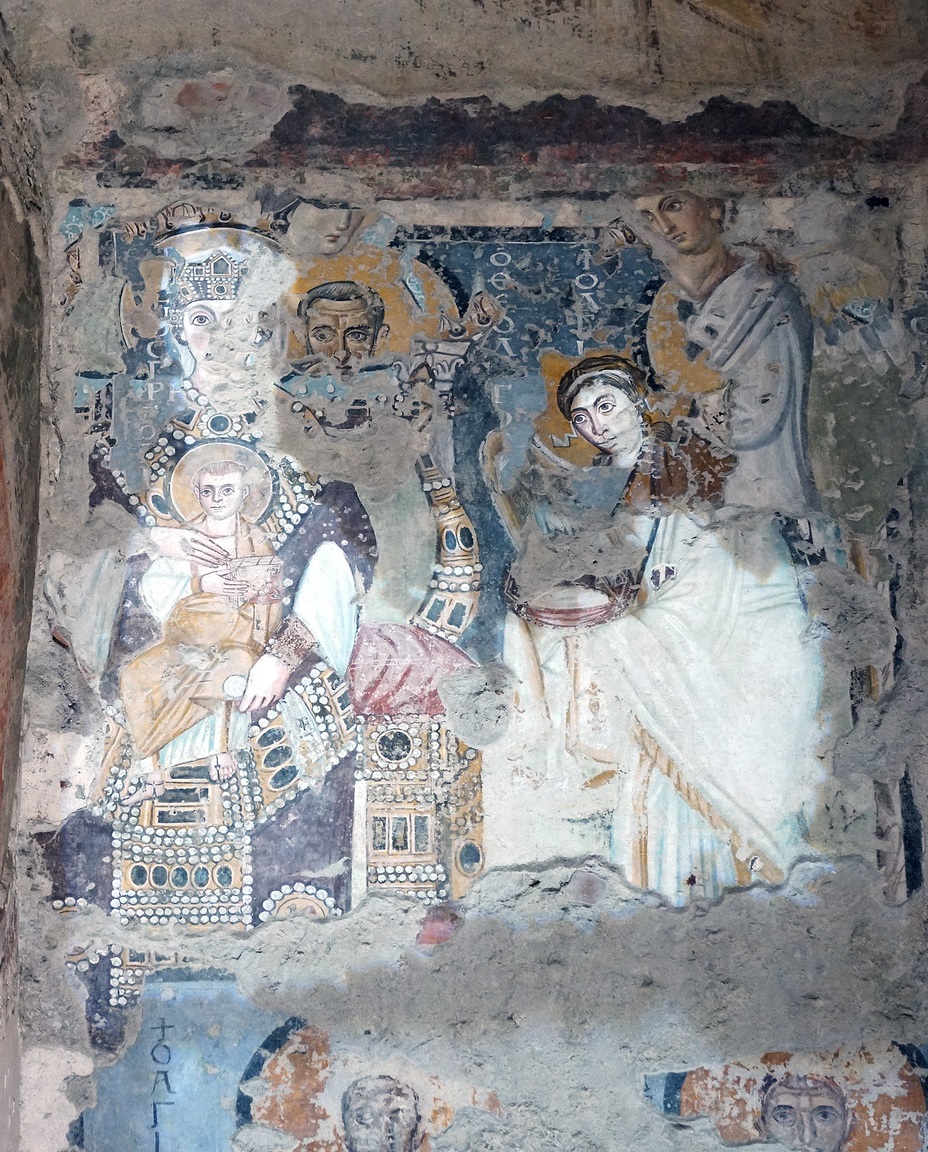
In the Roman Forum, nestled at the foot of the Palatine Hill, stands the ancient church of Santa Maria Antiqua. On its sanctuary wall, painted in the mid-6th century, is the oldest surviving image of Mary enthroned as Queen, known as the Maria Regina fresco. There, Our Lady sits robed in imperial splendor, originally flanked by angels who offered her a crown. From this first clear witness in art to today’s feast, the Church has proclaimed: the Mother of the King shares in her Son’s royal dignity, not for herself, but for us.
Unlike later medieval or Renaissance depictions that emphasize royal luxury, this early fresco shows Mary enthroned yet dignified in simplicity. She wears a crown, a sign not of earthly power but of heavenly dignity, given to her by God as the Mother of His Son. This image connects powerfully with the vision described in Revelation 12:1–5:
“A woman clothed with the sun, with the moon under her feet, and on her head a crown of twelve stars…” (Rev. 12:1)
Mary is the radiant woman, shining with the light of Christ. The sun symbolizes divine glory, the moon beneath her feet symbolizes her victory over change and darkness, and the crown of twelve stars signifies both her Queenship and her role as Mother of the Church—the new Israel, represented by the twelve tribes/apostles.
“She was with child and wailed aloud in pain as she labored to give birth.” (Rev. 12:2)
Mary bore Christ, the Savior of the world, and by extension shares in the labor of giving spiritual birth to us, the members of His Body. Her queenship is not distant or detached but motherly and close.
“Then another sign appeared in the sky; it was a huge red dragon…” (Rev. 12:3)
The dragon represents Satan, the enemy of life, always at war with the Woman and her offspring. Even as Queen, Mary is not portrayed as untouchable royalty but as a warrior-queen, battling on behalf of her children through her intercession.
“She gave birth to a son, a male child, destined to rule all the nations with an iron rod.” (Rev. 12:5)
This child is Jesus, the true King. Mary’s crown is inseparable from His kingship. She reigns only because she first served Him perfectly. Her glory reflects His glory.
The fresco of Maria Regina and John’s vision in Revelation points us to the same truth: Mary’s Queenship is not about domination but service. Her crown is not like the crowns of earthly rulers who grasp at power; it is a crown that serves—a crown of intercession, protection, and motherly care.
To honor Mary as Queen is to recognize the kind of reign she exercises: humble, maternal, and always pointing us back to Christ the King. Her crown shines because it is rooted in love.