
Feast Day: September 3rd
Patron Saint of Teachers, Students, Musicians
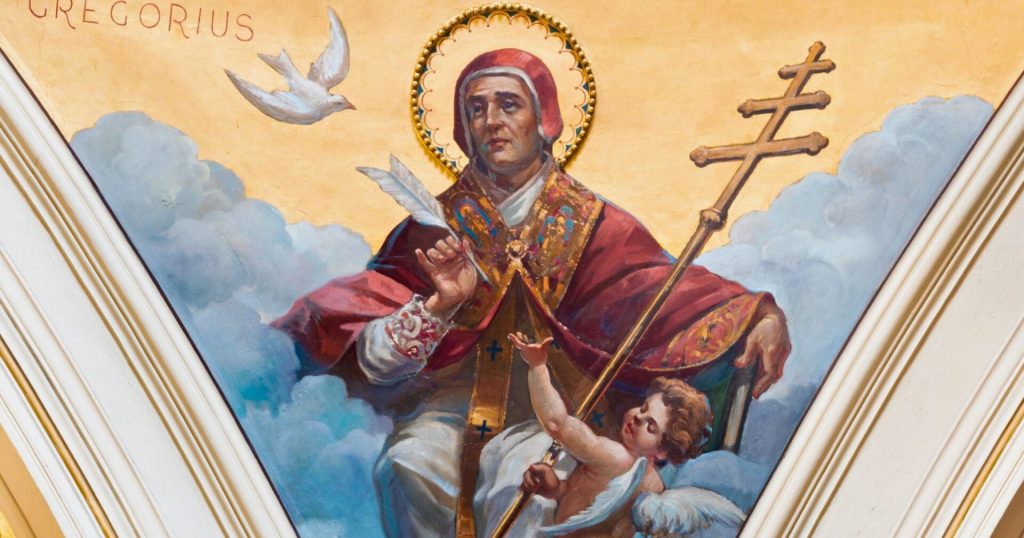
This artwork depicts Pope St. Gregory the Great, one of the four great Doctors of the Latin Church. He is shown wearing papal vestments and a halo, symbolizing his sainthood. The dove represents the Holy Spirit, said to have inspired his writings. The quill highlights his many theological works and contributions to Church teaching. He holds the papal cross staff, a sign of his authority as pope, while the angel at his side emphasizes his closeness to God and the heavenly realm. “Saint Gregory the Great” — Wikimedia Commons. Link to source
Pope St. Gregory the Great
Faith Journey
Born into an aristocratic and saintly Roman family, Gregory left a promising civil career as prefect of Rome around age 30 to embrace the monastic life, converting his family estate into a Benedictine monastery. At age 35 his ordained as a priest. After serving as envoy to Constantinople and abbot, he was reluctantly elected pope in 590 but accepted the role as servant of the servants of God. As pope, he shepherded a city beset by natural disasters and invasions, using church resources to ransom captives, feed the hungry, and negotiate peace—while safeguarding doctrinal integrity and supporting the vulnerable. A prolific writer, he authored the Pastoral Rule, Moralia in Job, letters, and homilies—he also reformed the liturgy and promoted mission work, including evangelization in England. Immediately acclaimed a saint upon his death in 604 and later declared Doctor of the Church, Gregory’s legacy as reformer, theologian, and spiritual physician endures. His feast day is celebrated on September 3, the anniversary of his election as pope.
Challenges and Virtues
Gregory’s papacy came at a time of crisis: famine, floods, and plague struck Rome, while the Lombards threatened the city’s gates. Instead of shrinking from these burdens, he used Church lands and resources to feed the hungry, care for the sick, and ransom captives. He worked tirelessly for peace, personally negotiating with invading rulers.
Though born into wealth and high office, Gregory embraced humility, calling himself the servant of the servants of God. His writings reveal a man deeply aware of his own weaknesses, yet trusting in God’s grace. He balanced strength and gentleness—firm in defending the faith, yet compassionate toward the poor, Jews, and all who suffered.
His virtues shine through his service: humility in leadership, charity in caring for the vulnerable, wisdom in guiding the Church through reform, and zeal in sending missionaries like St. Augustine of Canterbury to spread the Gospel. Gregory shows us that holiness is not about ease but about meeting trials with courage, compassion, and faith.
Canonization and Legacy
Gregory died on March 12, 604, after serving as pope for fourteen years. From the moment of his death, the people of Rome honored him as a saint, recognizing his holiness in both word and deed. His memory was celebrated so strongly that his canonization came not through a formal process but through the universal acclamation of the faithful.
In 1295, Pope Boniface VIII declared him a Doctor of the Church, placing him among the four great Western Doctors alongside St. Ambrose, St. Augustine, and St. Jerome. This title honors his profound wisdom and enduring writings, especially his Pastoral Rule and homilies, which continue to guide bishops and pastors today.
Gregory’s legacy also lives on in the Church’s worship and missionary spirit. The “Gregorian chant” tradition, named after him, shaped centuries of liturgical music. His reforms of the Mass and liturgy set a foundation still recognized today. And his missionary vision bore fruit in the conversion of England and beyond.
FUN FACTS