Feast Day: October 2
In Christian theology, a guardian angel is an angelic being assigned by God to protect, guide, and intercede for each human soul. The idea is ancient, rooted in Scripture and Tradition, and affirmed by many saints and theologians over the centuries.
From the moment a soul is created (or conceived), a guardian angel is assigned to accompany that person throughout life — as a protector, guide, and advocate before God. Some Church Fathers, like Honorius of Autun, affirmed that “every soul was assigned a guardian angel the moment it was put into a body.”
Thomas Aquinas likewise taught that since our life is full of dangers both internal and external, God assigns a guardian angel to each person so that “an angel is assigned to each man as long as he is a wayfarer.”
Angels are pure spiritual beings, created by God, without bodies. They are ministering spirits, and because they are closer to God, they can act as protectors, messengers, and guides. The guardian angel does not replace God’s providence, nor does he force us; but he assists, inspires, and intercedes.
Saints and Their Relationships with Guardian Angels
Many saints testified to a special friendship or awareness of their guardian angels. A few notable examples:
St. Padre Pio had a deep devotion to his guardian angel. From childhood, he spoke of playing with his angel, conversed with him, and treated him as a friend. Hozana.org+1 Padre Pio encouraged others to “summon your guardian angel … he will enlighten you and guide you” Hozana.org and wrote letters reminding souls to converse with their angel, offering their thoughts, prayers, sufferings to them. Hozana.org
St. Gemma Galgani is often said to have had visionary experiences with her guardian angel. (Many hagiographies mention her angelic companionship.)
Throughout Christian history, many mystics and saints have recounted the help of angels in battles of temptation, in consolations, and in spiritual discernment.
These saintly attachments underscore the belief that the guardian angel is more than a distant guardian — he is a faithful companion.
Guardian Angels and Parenthood / Ordination
The traditional Catholic understanding holds that every person is assigned a guardian angel. This includes newborn children: from the moment of life, a child receives a guardian angel whose role is to watch over, guide, and protect as the child grows.
Likewise, when someone is ordained a priest (or enters a religious vocation), his guardian angel continues to accompany him, guiding him in ministry, protecting him from spiritual dangers, and interceding for him. The notion is that the angel remains assigned to the soul regardless of status or vocation — thus, a priest’s guardian angel helps in his pastoral life and spiritual struggles.
In this way, the angel provides continuity throughout life from infancy to adulthood and through one’s calling.
The Nine Choirs of Angels
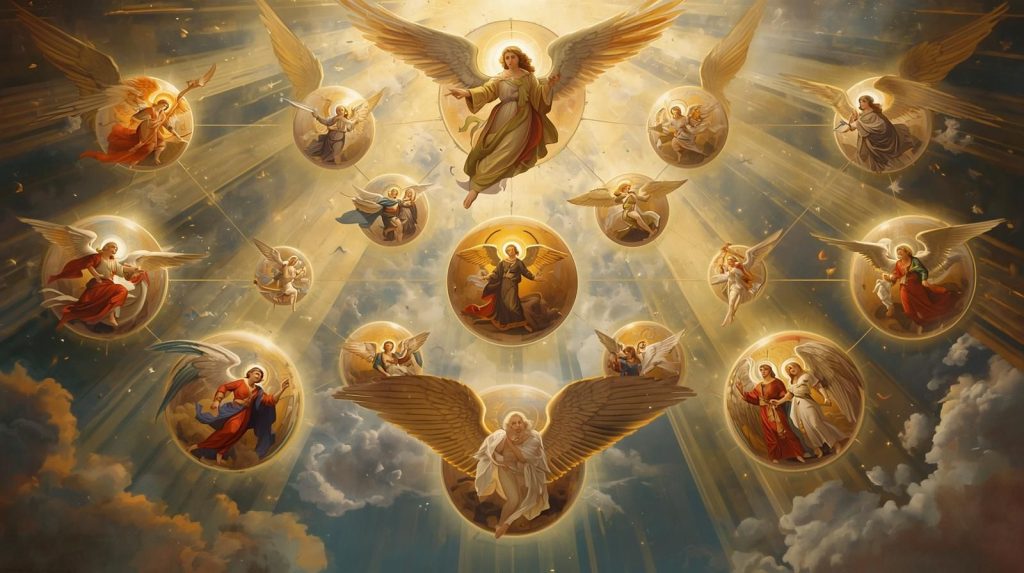
9 Choirs of Angels
Christian tradition often categorizes angels into nine “choirs” or orders, grouped into three spheres (or triads). Though the Bible does not explicitly enumerate them, the hierarchy is drawn from theological reflection (notably by Pseudo‑Dionysius the Areopagite) and in later medieval theology (Thomas Aquinas, etc.). Here is a common ordering:
First Sphere (closest to God):
1. Seraphim
2. Cherubim
3. Thrones
Second Sphere:
4. Dominions (Dominations)
5. Virtues
6. Powers
Third Sphere (closest to humanity):
7. Principalities
8. Archangels
9. Angels
The Seraphim are consumed with the love of God and cry “Holy, holy, holy.”
The Cherubim are guardians of divine mysteries and shine with inner knowledge.
The Thrones are the bearers of divine justice and humility.
The Dominions supervise lower orders of angels.
The Virtues bestow grace and perform miracles.
The Powers are warrior angels, guard against evil.
The Principalities guide nations, institutions.
The Archangels (Michael, Gabriel, Raphael) carry God’s messages and lead legions.
The Angels are the lowest choir — the ones who interact with human beings and include our guardian angels.
Our guardian angels belong to that ninth choir, the “Angels,” because their special mission is service to individual human souls.
Biblical Verses About Guardian Angels
While the Bible does not use the exact phrase “guardian angel” often, several passages are traditionally interpreted as supporting the doctrine:
Matthew 18:10 — “See that you do not despise one of these little ones, for I say to you that in heaven their angels always see the face of my Father who is in heaven.” (This implies angels assigned to “little ones” that are attentive to God’s presence.)
Psalm 91:11–12 — “For he will command his angels concerning you, to guard you in all your ways; they will bear you up on their hands, so that you will not dash your foot against a stone.”
Hebrews 1:14 — “Are not all angels ministering spirits sent to serve those who will inherit salvation?”
Exodus 23:20–22 — “Behold, I send an angel before you to guard you on the way and to bring you to the place which I have prepared.”
(Also, in the Gospels, when Jesus speaks of angels of little ones, and in the Book of Acts, when Peter is delivered from prison: “John said, ‘It must be his angel’” [Acts 12:15], showing that people believed in angelic guardians.)
Guardian Angel Prayer
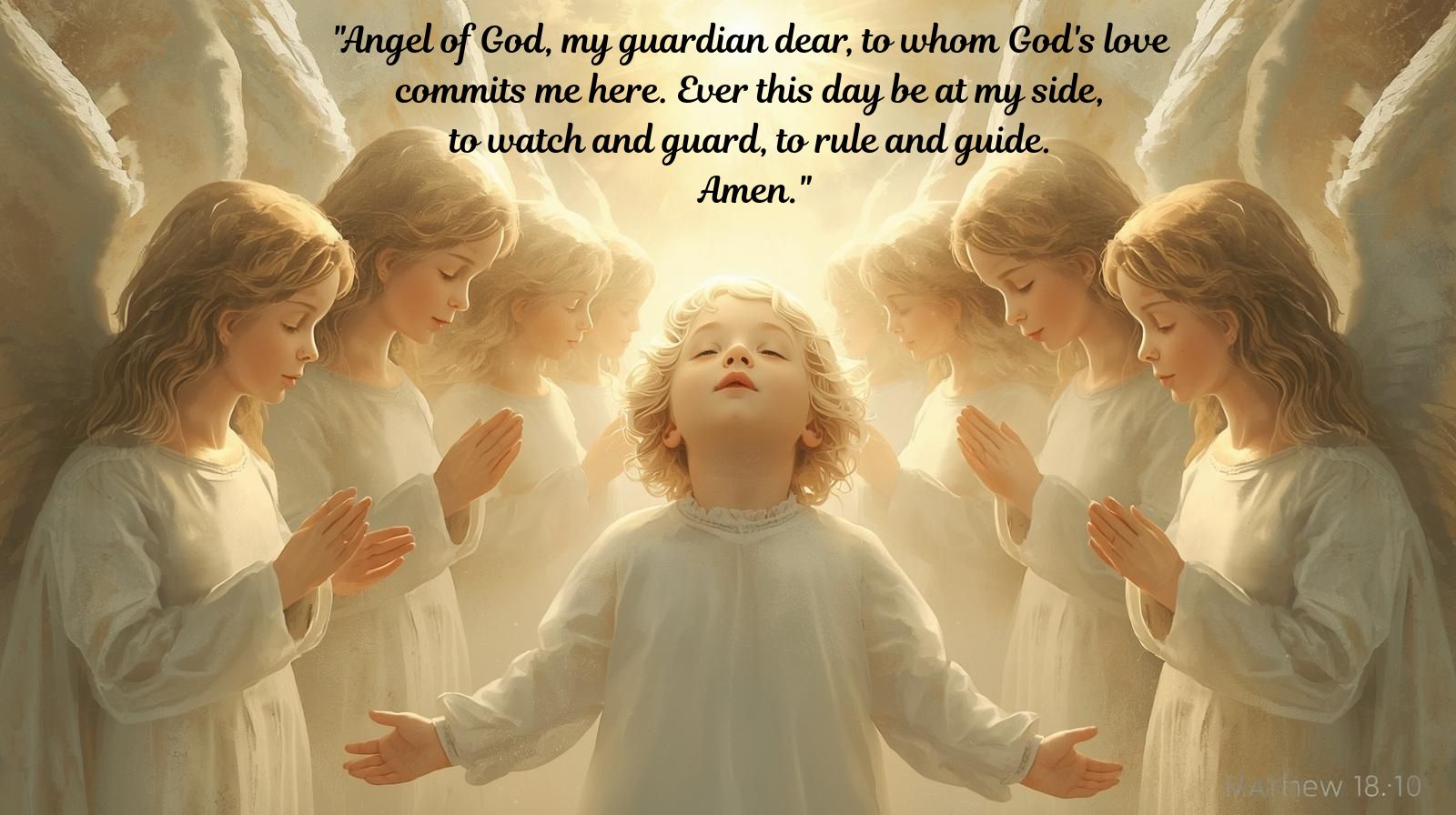
“Angel of God, my guardian dear,
to whom God’s love commits me here,
ever this day (or night) be at my side,
to light and guard, to rule and guide. Amen.“
Padre Pio also prayed:
“Angel of God, my guardian,
to whom the goodness of the Heavenly Father entrusts me,
enlighten, protect and guide me now and forever.” Hozana.org
FUN FACTS